

In the world of industrial fluid handling, mechanical seals are the unsung heroes that prevent leaks and ensure operational integrity. Among the various types, the choice between a Cartridge Mechanical Seal and a Component Mechanical Seal is a critical decision that impacts installation time, maintenance costs, and overall system reliability. This article provides a detailed comparison to help engineers and maintenance professionals make an informed choice.
A cartridge mechanical seal is a pre-assembled, self-contained unit. It comes as a single package that includes all necessary components: the seal faces (rotating and stationary), springs, secondary seals (O-rings), a sleeve, and a gland plate. The entire assembly is factory-set to the correct working length and spring compression. This design means the cartridge mechanical seal is ready to be installed as a complete module without the need for on-site assembly or adjustment.
Also known as a "non-cartridge" or "traditional" seal, this type consists of individual, separate parts. The installer receives a box containing the rotating face, stationary seat, springs, and O-rings. These components must be manually assembled piece by piece onto the pump shaft and into the stuffing box during installation. This process requires careful measurement and alignment by a skilled technician.
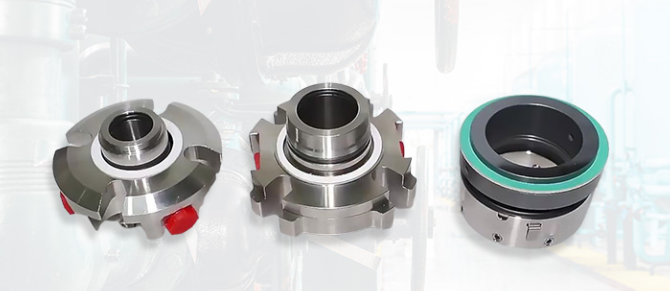
This is the most significant differentiator between the two types.
| Aspect | Cartridge Mechanical Seal | Component Mechanical Seal |
|---|---|---|
| Assembly | Factory-assembled. No need to handle individual small parts. | Field-assembled. Technician must assemble all parts on-site. |
| Skill Level | Low skill required. Often described as "plug-and-play." | High skill required. Requires expertise in alignment and compression setting. |
| Time | Fast (minutes). Simply slide onto the shaft and bolt the gland. | Slow (30+ minutes). Involves measuring spring compression and aligning faces. |
| Risk of Error | Low. Pre-set design eliminates measurement errors. | High. Incorrect spring setting or misalignment can cause immediate failure. |
The installation of a cartridge mechanical seal is straightforward: clean the shaft, slide the cartridge into place, bolt the gland plate to the pump housing, and remove the shipping clips. In contrast, installing a component mechanical seal involves setting the spring compression, carefully placing O-rings, and ensuring the faces are perfectly square to the shaft, a process prone to human error.
Offers higher functional security. Because the seal is pre-assembled in a controlled environment, the risk of dirt contamination during installation is minimized. The fixed axial settings prevent the faces from being misaligned, leading to more consistent performance and longer seal life. They are also better suited for handling hazardous or abrasive media because the enclosed design protects the internal components.
Reliability is highly dependent on the installer's skill. A perfectly installed component seal can perform as well as a cartridge seal. However, if the spring compression is set too high or too low, or if the faces are not square, the seal may leak immediately or fail prematurely. The exposed nature of the components during handling also makes them more vulnerable to damage.
Component mechanical seals are generally less expensive upfront. They have fewer metal parts (no sleeve or complex gland) and are simpler to manufacture.
Cartridge mechanical seals often provide better value in the long run. While the unit cost is higher, the savings in reduced installation time, minimized downtime, and lower risk of failure due to installation error can outweigh the initial price difference. For critical applications where pump downtime is costly, the cartridge seal's reliability is a major economic advantage.
Maintenance is simplified. When a seal fails, the entire cartridge is typically replaced as a unit. This is a quick process that gets the pump back online rapidly. Some cartridge designs allow for the replacement of wear parts like faces or O-rings, but this is less common.
Offers more flexibility in repairs. If only the stationary seat is damaged, it can be replaced without changing the rotating face or springs. This can reduce spare parts inventory costs, as you only need to stock individual components rather than complete cartridges.
Downtime is critical (e.g., in continuous process industries like chemical or power generation).
Installation is performed by general maintenance staff without specialized seal training.
The application involves hazardous, toxic, or abrasive fluids where leakage cannot be tolerated.
Space permits the slightly larger physical footprint of the cartridge unit.
Budget is a primary constraint and the initial purchase price must be minimized.
The pump has very limited space and cannot accommodate the bulkier cartridge assembly.
Skilled technicians are always available for precise installation and alignment.
The application is for general service (water, light oils) where the consequences of a minor leak are low.
The decision between a cartridge and a component mechanical seal is not about which is "better" in absolute terms, but about which is more appropriate for your specific situation.
Cartridge mechanical seals are the champions of efficiency and reliability, reducing human error and maximizing uptime.
Component mechanical seals are the masters of economy and flexibility, offering a lower entry cost and adaptability to tight spaces.
By understanding these fundamental differences, you can select the seal that optimizes both performance and cost for your operation.
Get Professional Seal Consultation from MIAOYU
Our company is specialized in the production of sealing materials, mechanical seals , cartridge seals.
E-mail: gechacha@aliyun.com
Mobile: +86-18758835650
WhatsApp: +86-18758835650
Add: No8-2, Jinsha road Yuelin Street, Fenghua District, Ningbo, Zhejiang


