

In the world of industrial fluid handling, the mechanical seal is the guardian of containment, preventing process fluids from escaping into the environment while keeping contaminants out. Among the most fundamental classifications of these critical components is the distinction between pusher-type and non-pusher-type mechanical seals. This difference, rooted in the mechanism used to maintain face contact, dictates performance, reliability, and suitability for specific applications. Understanding this dichotomy is essential for engineers, maintenance teams, and procurement specialists aiming to maximize equipment uptime and safety.
At its core, the difference between pusher and non-pusher seals lies in the behavior of the secondary sealing element—the component that seals the gap between the rotating seal face and the shaft or sleeve.
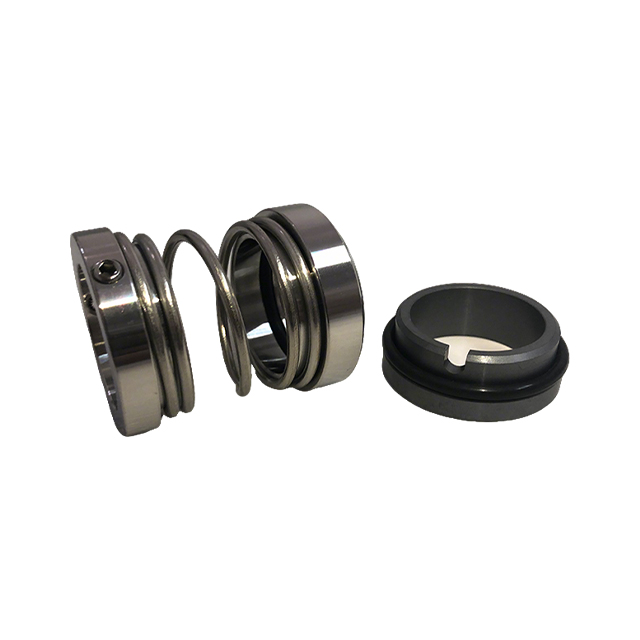
Pusher Seals (Dynamic Secondary Seal): These designs utilize a dynamic secondary seal, typically an O-ring, PTFE wedge, or U-cup. This component must slide axially (push) along the shaft or sleeve to compensate for face wear and axial shaft movement. The spring force acts directly on the seal head, pushing the dynamic seal forward to maintain face contact.
Non-Pusher Seals (Static Secondary Seal): Also known as bellows seals, these designs feature a secondary seal that remains static relative to the shaft. The compensation for wear and movement is achieved through the flexing, compression, or extension of a bellows element (elastomer, metal, or PTFE). The bellows acts as both the spring and the secondary seal, eliminating the need for sliding parts.
Pusher seals are the traditional workhorses of the industry, characterized by their robust construction and high-pressure capability.
Key Components:
Primary Seal Faces: The rotating face (usually carbon) and stationary face (usually ceramic, silicon carbide, or tungsten carbide).
Spring(s): Multiple small springs or a single large coil spring that provides the closing force.
Dynamic Secondary Seal: An elastomeric O-ring or a PTFE wedge that is compressed between the rotating face holder and the shaft.
How It Works:
As the primary seal faces wear down over time, the gap between them would normally increase, leading to leakage. In a pusher seal, the constant force from the springs pushes the entire rotating assembly forward. This action forces the dynamic secondary seal to slide along the shaft surface, maintaining intimate contact between the primary faces. This "pushing" action is continuous and automatic, allowing the seal to track axial shaft movement (end-play) and compensate for face wear.
Common Examples: John Crane Type 1, Type 8B; Chesterton 442; Flowserve Plan 11 seals.
Non-pusher seals are modern designs prized for their reliability in harsh conditions. They are subdivided into elastomer bellows, metal bellows, and PTFE bellows seals.
Key Components:
Primary Seal Faces: Identical in function to pusher seals.
Bellows Element: This is the defining component. It is a convoluted, flexible membrane.
Elastomer Bellows: Made of NBR, EPDM, FKM, etc. The bellows itself provides the spring force through its elasticity.
Metal Bellows: Made of thin, welded metal plates (often AM350 or Hastelloy). The bellows flexes to provide the force.
Static Secondary Seal: The ends of the bellows are bonded or clamped to the shaft and the face holder. There is no axial sliding at these interfaces.
How It Works:
Instead of sliding a seal along the shaft, the bellows design accommodates wear by flexing. As the faces wear, the bellows compresses or extends like an accordion. The secondary seal points (where the bellows attaches to the shaft and the face) remain fixed. This design eliminates the friction and hang-up points associated with dynamic O-rings.
Common Examples: John Crane Type 6 (Elastomer Bellows), Type 28 (Metal Bellows); API 682 Arrangement 3 seals.
Feature | Pusher Seal | Non-Pusher Seal |
|---|---|---|
Secondary Seal Action | Dynamic (Slides) | Static (Fixed) |
Shaft Fretting | High Risk. The sliding O-ring can groove the shaft/sleeve over time, especially with vibration. | Low Risk. No sliding motion protects the shaft from wear. |
Hang-up/Clogging | Susceptible. Solids, crystallized fluids, or carbonized grease can cause the O-ring to stick, preventing face contact. | Resistant. The absence of a sliding interface and the open structure of bellows make them less prone to clogging. |
Pressure Capability | High. Can handle very high pressures (often > 1000 psi) due to robust spring support. | Variable. Elastomer bellows are limited to moderate pressures. Metal bellows can handle high pressures but are sensitive to pressure-induced stress. |
Temperature Range | Limited by the elastomer of the O-ring (typically -40°C to 200°C for FKM). | Wider. Elastomer bellows similar to pusher. Metal bellows excel in extreme temperatures (-200°C to 800°C). |
Abrasive Media | Poor. Abrasives can ingress behind the O-ring, causing rapid shaft wear and seal failure. | Better. The bellows design can often exclude solids from the critical sealing area. |
Cost | Generally lower initial cost. | Generally higher initial cost, especially for metal bellows. |
Reliability in Dirty Service | Lower; requires clean flush. | Higher; often specified for wastewater, slurries, and solids-laden fluids. |
Choosing between a pusher and a non-pusher seal is a trade-off between cost, pressure requirements, and environmental harshness.
Choose a Pusher Seal When:
Cost is a primary driver for general service applications.
Sealing clean, non-polymerizing fluids like water, light hydrocarbons, or clear chemicals.
High-pressure applications exceed the limits of elastomer bellows seals.
Shaft sleeves are used and can be easily replaced if grooving occurs.
Choose a Non-Pusher Seal When:
The fluid is abrasive or contains solids (e.g., wastewater, pulp and paper stock, slurries). The non-clogging nature of the bellows is critical.
Shaft protection is paramount and sleeve replacement is undesirable or impossible.
The fluid tends to crystallize, polymerize, or solidify (e.g., caustic, some polymers, syrups), which would cause a pusher seal's O-ring to hang up.
High-temperature applications requiring a metal bellows design.
Hazardous or toxic fluids where maximum reliability and zero leakage are mandated (metal bellows are often specified in API 682 for these services).
Historically, pusher seals dominated due to their simplicity and lower manufacturing cost. However, the trend in modern industrial standards, particularly API 682 (Shaft Sealing Systems for Centrifugal and Rotary Pumps), has shifted towards favoring non-pusher designs for critical services. Metal bellows seals are often specified as the default for Plan 53/54 dual seal systems and for handling volatile organic compounds (VOCs) due to their superior reliability and elimination of dynamic seal hang-up.
For general-purpose and OEM applications, the elastomer bellows non-pusher seal (like the John Crane Type 6) has become extremely popular. It offers a compelling middle ground: the shaft protection and clog resistance of a non-pusher design with a cost closer to that of a traditional pusher seal.
The choice between a pusher and a non-pusher mechanical seal is not about which is universally better, but about which is appropriate for the specific operating environment. Pusher seals offer economical, high-pressure performance in clean services. Non-pusher seals provide robust, maintenance-free operation in dirty, abrasive, or high-temperature environments by eliminating the failure modes associated with sliding dynamic seals. By understanding the fundamental mechanics of how each type maintains face contact, engineers can make informed decisions that enhance pump reliability, protect valuable equipment, and ensure environmental compliance.

Our company is specialized in the production of sealing materials, mechanical seals , cartridge seals.
E-mail: gechacha@aliyun.com
Mobile: +86-18758835650
WhatsApp: +86-18758835650
Add: No8-2, Jinsha road Yuelin Street, Fenghua District, Ningbo, Zhejiang


