

In the intricate world of fluid containment, the mechanical seal stands as a critical component, tasked with preventing leakage along rotating shafts in pumps, mixers, and compressors. While the previous discussions on pusher vs. non-pusher and single vs. double seals addressed structural dynamics and safety redundancy, the distinction between balanced and unbalanced mechanical seals delves into the core physics of pressure management. This classification is not based on the seal's physical movement but on the geometric relationship between the seal faces and the hydraulic forces acting upon them. The choice between these two types fundamentally determines the seal's ability to handle pressure without generating destructive heat and wear.
The primary differentiator is the Balance Ratio (B), also known as the Load Factor (K). This dimensionless number is defined as the ratio of the hydraulic closing area (A_h) to the seal face contact area (A_f).
B = A_h / A_f
Unbalanced Seal: B ≥ 1.0
Balanced Seal: B < 1.0 (Typically 0.65 to 0.85)
This seemingly simple mathematical ratio dictates the entire operational envelope of the seal.
An unbalanced seal is characterized by a design where the hydraulic closing area is equal to or greater than the face contact area. In practical terms, this means the shoulder of the shaft or sleeve is located outside the seal face, or the seal face itself is relatively small. This geometry allows the full force of the process pressure to act upon the back of the seal's rotating face.
When the pump is pressurized, the fluid pressure pushes the rotating face against the stationary face with a force proportional to the pressure multiplied by the hydraulic area. Since B ≥ 1, the Net Face Pressure (NFP)—the actual pressure squeezing the faces together—increases linearly and significantly with rising system pressure.
NFP = Spring Pressure + (Balance Ratio - 1) × System Pressure
For an unbalanced seal (B=1.2), if the system pressure rises to 100 psi, the force on the faces increases dramatically. While this ensures the seal remains closed, it comes at a cost: friction.
Advantages: Lower manufacturing cost, simpler geometry, excellent for low-pressure applications where high face load is needed to maintain contact (e.g., with viscous fluids).
Limitations:Limited Pressure Capability. As pressure increases, the NFP rises, leading to excessive heat generation (high PV value), rapid face wear, and potential blistering of carbon faces. Unbalanced mechanical seals are generally restricted to pressures below 50-100 psi (0.35-0.7 MPa) for water-like fluids and even lower for non-lubricating fluids.
A balanced mechanical seal is engineered to reduce the effect of system pressure on the seal faces. This is achieved by introducing a step in the shaft or sleeve, effectively reducing the hydraulic closing area (A_h). The seal face is partially "unloaded" from the system pressure.
By setting the balance diameter (the point where the secondary seal slides) between the inner and outer diameters of the seal face, the designer creates a condition where only a fraction of the system pressure contributes to closing the seal. With B < 1, the term (B - 1) in the NFP formula becomes negative, meaning the system pressure actually works to reducethe net closing force.
Example: For a balanced mechanical seal with B=0.75 and a system pressure of 500 psi, the hydraulic component of the force is (0.75 - 1) × 500 = -125 psi. This subtracts from the spring load, preventing the faces from being crushed together.
Advantages:High-Pressure Capability. Balanced seals can operate in ranges exceeding 1000 psi (7 MPa) and even up to 3000 psi in specialized designs. They generate less heat, exhibit lower wear rates, and have a much longer service life in demanding services.
Applications: Virtually all API 682 standard seals for refinery and chemical service are balanced. They are mandatory for handling volatile organic compounds (VOCs), light hydrocarbons, and high-speed applications.
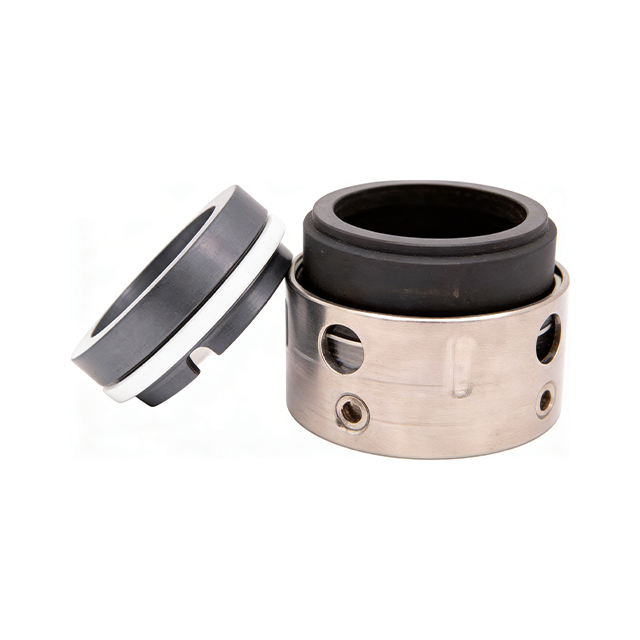
Parameter | Unbalanced Mechanical Seal | Balanced Mechanical Seal |
|---|---|---|
Balance Ratio (B) | ≥ 1.0 (typically 1.1 - 1.3) | < 1.0 (typically 0.65 - 0.85) |
Pressure Limit | Low (0 - 100 psi typical) | High (500 - 3000+ psi) |
Heat Generation | High at elevated pressure | Low and stable |
Wear Rate | High under pressure | Low, consistent |
Cost | Lower initial cost | Higher initial cost |
Shaft/Sleeve | Simple cylindrical surface | Requires precision step or balance diameter |
Ideal For | Low-pressure water, non-volatile liquids, OEM cost-sensitive pumps | Refineries, chemical plants, high-pressure pumps, volatile liquids, abrasive services |
The limitation of unbalanced mechanical seals is not a lack of strength but a thermodynamic problem. The PV value (Pressure × Velocity) is a measure of the frictional energy generated at the seal faces. For any given material pair (e.g., Carbon vs. Silicon Carbide), there is a maximum PV limit.
In an unbalanced mechanical seal: P_face ≈ System Pressure × B. If B=1.2 and system pressure is 200 psi, P_face is high.
In a balanced mechanical seal: P_face ≈ Spring Load + (Small Fraction of System Pressure). At 200 psi system pressure, P_face remains manageable.
Exceeding the PV limit causes the lubricating fluid film between the faces to vaporize (flashing), leading to dry running, cracking, and catastrophic failure. Balanced seals keep the face load within the material's thermal limits.
The decision to use a balanced or unbalanced mechanical seal follows a clear logic based on pressure and fluid properties:
Use an Unbalanced Mechanical Seal if: The seal chamber pressure is below 0.7 MPa (100 psi), the fluid has good lubricity (e.g., oil, diesel), the fluid is non-volatile, and cost is a primary driver. Common in general-purpose water pumps and low-duty chemical pumps.
Use a Balanced Seal if:
Seal chamber pressure exceeds 0.7 MPa.
The fluid has poor lubricity (e.g., water, caustic, solvents).
The fluid is volatile and prone to vaporize at the seal faces (e.g., propane, butane, light hydrocarbons). A balanced mechanical seal runs cooler, preventing vaporization.
The application requires compliance with API 682, which specifies balanced designs for most hydrocarbon services regardless of pressure to ensure low emissions and long life.
The difference between balanced and unbalanced mechanical seals is a masterclass in mechanical engineering leverage. An unbalanced mechanical seal uses the brute force of system pressure to maintain closure, a strategy that fails when pressure escalates. A balanced seal, through intelligent geometry, "fools" the pressure into working for it, creating a stable, cool-running interface capable of withstanding extreme conditions. In modern industrial practice, the balanced mechanical seal is the undisputed standard for reliability, safety, and performance, while the unbalanced seal retains its niche in the simplest of duties.

Our company is specialized in the production of sealing materials, mechanical seals , cartridge seals.
E-mail: gechacha@aliyun.com
Mobile: +86-18758835650
WhatsApp: +86-18758835650
Add: No8-2, Jinsha road Yuelin Street, Fenghua District, Ningbo, Zhejiang


