

In the intricate world of fluid containment, the mechanical seal is a cornerstone of reliability for pumps, mixers, and compressors. While all mechanical seals operate on the principle of two precisely lapped faces running against each other, the classification of Stationary and Rotating (often termed "Dynamic") refers not to the faces themselves, but to the location of the compensation mechanism—the spring or bellows that maintains face contact. This seemingly subtle design choice has profound implications for performance, speed capability, and application suitability.
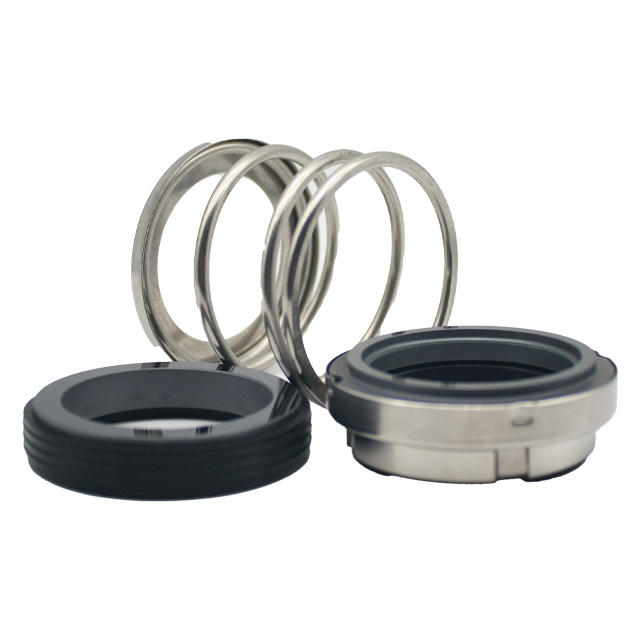
In a rotating seal, the entire assembly that includes the spring, the flexible secondary seal (O-ring or bellows), and the primary sealing face (usually the softer carbon ring) is mounted on and rotates with the shaft. The mating ring (usually the hard face, e.g., Silicon Carbide) is fixed to the stationary housing. The compensation for wear, shaft end-float, and misalignment is achieved by the rotating components sliding axially along the shaft or sleeve.
Key Identifier: The spring spins with the shaft.
In a stationary seal, the roles are reversed. The spring and the flexible element are mounted on the stationary side of the seal (the gland plate or housing). The primary sealing face that is pushed by the spring does not rotate. The mating ring is mounted on the shaft and rotates. The compensation for wear and movement is achieved by the stationary face moving axially within the gland, independent of shaft rotation.
Key Identifier: The spring is fixed; only the hard face rotates.
The fundamental physics governing both types is identical: a combination of spring force and hydraulic pressure creates a net face load that presses the faces together, while a microscopic fluid film provides lubrication. The divergence occurs in how dynamic forces are managed.
Centrifugal Force: Since the spring and its retainer rotate, they are subject to centrifugal force. At high speeds, this force can cause the spring to expand radially, potentially altering the spring load or causing imbalance.
Solids Buildup: In services with crystallizing or solids-laden fluids, the rotating assembly can act as a centrifuge, throwing solids outward. These solids can accumulate in the spring cavity, potentially clogging the mechanism and preventing the seal from flexing, leading to failure.
Hysteresis: The rotating secondary seal (e.g., a pusher O-ring) must slide on the shaft to compensate for movement. This sliding friction can cause the seal to lag behind rapid axial shaft movements (hysteresis), momentarily opening the faces and causing leakage or damage.
Zero Centrifugal Effect: The spring remains static. Its load is constant regardless of rotational speed, eliminating speed-induced load variations.
Clean Environment: The stationary spring cavity is not subject to centrifugal particle separation. It is often easier to flush clean or is isolated from the process fluid by design.
Responsive Tracking: The stationary face, being unencumbered by rotational inertia, can respond more quickly to axial shaft movements and vibrations, maintaining better face contact.
Parameter | Rotating Mechanical Seal | Stationary Mechanical Seal |
|---|---|---|
Speed Capability | Limited. Typically max 20-25 m/s surface speed due to centrifugal effects. | High. Capable of 100+ m/s. Ideal for high-speed pumps, turbines, and compressors. |
Handling Solids/Abrasives | Poor. Prone to clogging in the rotating spring cavity. | Excellent. The stationary cavity is less likely to pack with solids. Metal bellows stationary seals are the gold standard for abrasive services. |
Cost & Complexity | Lower cost, simpler manufacturing. Common in OEM and general-purpose pumps. | Higher initial cost, more complex gland design. |
Balance & Stability | Can be unbalanced at high speeds, leading to vibration. | Inherently stable; no rotating mass to cause imbalance. |
Secondary Seal Friction | High (sliding on rotating shaft). Can cause hang-up. | Low (sliding on stationary sleeve/housing). More reliable tracking. |
Axial Space Requirement | Compact on the shaft. | Requires more axial space in the gland plate. |
The choice between stationary and rotating is dictated by the operating envelope defined by the American Petroleum Institute (API) Standard 682, the global benchmark for seal selection.
General Purpose Services: Clean water, light oils, non-polymerizing chemicals at moderate speeds (< 3600 RPM on standard shaft sizes).
Cost-Driven Applications: Where initial equipment cost is a primary concern and the operating conditions are benign.
Small Diameter Shafts: Where the centrifugal force on the spring is negligible due to small radius.
High Speed: When the seal face surface speed exceeds 25 m/s (approximately 5000 RPM on a 4-inch diameter seal). API 682 mandates stationary designs for speeds over 23 m/s.
Abrasive or Slurry Services: Such as mining, pulp and paper, and wastewater. Stationary metal bellows seals eliminate the pusher mechanism that can clog.
Volatile or Crystallizing Fluids: Light hydrocarbons, caustic potash, or amines where solids formation would jam a rotating pusher seal.
High Temperature: Stationary mechanical seals, particularly welded metal bellows, handle thermal expansion better without the risk of a secondary seal sticking on a hot shaft.
API Pumps (API 610): For severe duty pumps in refineries and chemical plants, stationary seals are often specified for their reliability and long life.
The discussion of stationary vs. rotating is deeply intertwined with the type of flexible element. Welded Metal Bellows seals are almost exclusively designed as stationary.
Reason: A rotating metal bellows would be subject to tremendous centrifugal stress, potentially leading to fatigue failure. By making the bellows stationary, it becomes a highly robust component capable of handling temperature extremes, abrasives, and vacuum/pressure cycling without the weakness of a dynamic O-ring.
Rotating Mechanical Seals: Installation requires care to ensure the rotating face is square to the shaft. They are often supplied as component seals, requiring skilled assembly.
Stationary Mechanical Seals: Typically supplied as cartridge seals. The entire assembly (gland, stationary element, rotating face) is pre-assembled and preset. Installation is a simple "slide-on and bolt-down" procedure, eliminating installation errors and making them ideal for critical services where reliability is paramount.
The difference between stationary and rotating mechanical seals is a strategic design decision balancing cost against performance. The rotating seal is the workhorse of low-to-mid-range applications, offering simplicity and economy. The stationary seal is the engineered solution for the extremes: high speed, high abrasion, and high reliability. In modern industrial practice, the trend is decisively shifting towards stationary cartridge seals, as the value of reduced downtime and extended mean time between failures (MTBF) far outweighs the higher initial purchase price.

Our company is specialized in the production of sealing materials, mechanical seals , cartridge seals.
E-mail: gechacha@aliyun.com
Mobile: +86-18758835650
WhatsApp: +86-18758835650
Add: No8-2, Jinsha road Yuelin Street, Fenghua District, Ningbo, Zhejiang


