

A comprehensive technical guide to selecting the correct mechanical seal configuration for your centrifugal pump's specific duty.
Centrifugal pumps are the workhorses of countless industries—from municipal water supply and chemical processing to HVAC and power generation. While their principle of operation is straightforward, their reliability hinges on one critical component: the mechanical seal. Unlike traditional packing, mechanical seals provide leak-free operation, reduce friction, and extend pump life. However, not all seals are created equal. Selecting the correct type for a centrifugal pump’s specific duty is essential for performance and cost-efficiency.
This guide breaks down the most common mechanical seal configurations used in centrifugal pumps and their ideal applications.
Pusher seals are the most traditional and widely recognized type of mechanical seal. They utilize a dynamic secondary seal (typically an O-ring or wedge) that moves axially along the shaft or sleeve as the seal faces wear.
How They Work: A spring (or multiple springs) pushes the seal faces together. As wear occurs, the dynamic O-ring slides to maintain contact pressure.
Key Characteristics:
Design: Single or multiple springs.
Secondary Seal: O-ring, PTFE wedge, or elastomeric boot.
Cost: Generally the most economical option.
Pros: Simple and robust design; easy to repair and replace; suitable for a wide range of pressures and temperatures (within limits).
Cons: The dynamic O-ring can suffer from "hang-up" (stiction) due to heat, coking, or chemical attack, leading to face opening and leakage. Not ideal for services with significant shaft deflection or vibration.
Best Applications: General-purpose water pumps, HVAC systems, and light industrial services where the fluid is relatively clean and temperatures are moderate (below 250°F / 120°C). Common industry standards include API Type 1 (unbalanced) and Type 2 (balanced).
Metal bellows seals represent a significant evolution in seal technology, designed to overcome the limitations of pusher-type seals, particularly in high-temperature and high-vibration environments.
How They Work: A welded metal bellows (typically made from AM350, Inconel 718, or Hastelloy C276) replaces the coil springs and dynamic O-ring. The bellows acts as both the spring element and the secondary seal, flexing to accommodate shaft movement and face wear.
Key Characteristics:
Design: Balanced or unbalanced.
Secondary Seal: Static gaskets/O-rings only (no dynamic sliding parts).
Movement: Axial flexing of the bellows.
Pros: No Dynamic O-ring eliminates "hang-up," making them perfect for high-temperature services (>400°F / 200°C), steam, and hot oils. Offers excellent resistance to thermal shock, shaft runout, and longer life in services with shaft vibration.
Cons: Higher initial cost than pusher seals. Bellows fatigue can be a concern in highly cyclic operations if not properly designed.
Best Applications: Refinery and petrochemical pumps, boiler feed pumps, hot oil circulation, and any service where thermal expansion or coking is a concern. Common configurations include API Type 60 (unbalanced) and Type 65 (balanced).
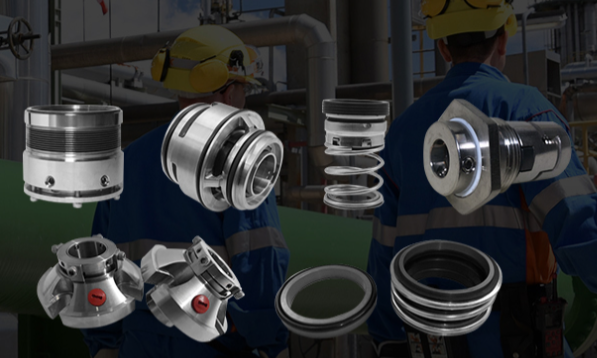
While "cartridge" refers more to a packaging method than a functional principle, it has become a dominant category for centrifugal pumps due to its ease of installation and reliability. A cartridge seal is a pre-assembled, factory-set unit that includes the seal, gland, sleeve, and hardware.
How They Work: The entire seal assembly is installed as a single unit. The torque is transmitted via set screws or a clamp, eliminating the need for field measurements of spring compression.
Key Characteristics: Can be either pusher-type or metal bellows construction internally; features a built-in gland and sleeve.
Pros: Error-proof installation that virtually eliminates installation-related failures. Significantly reduces downtime (faster replacement) and improves overall operator safety.
Cons: Typically higher cost per unit than component seals. Requires sufficient clearance on the pump shaft for installation.
Best Applications: Process industries (where speed is critical), water treatment plants (quick change-outs), and replacement markets as direct drop-in upgrades (e.g., Type 1 or Type 21 style cartridge seals).
For hazardous, toxic, or abrasive fluids, a single seal is often insufficient. Double seals use two sets of seal faces with a buffer or barrier fluid in between.
How They Work:
Back-to-Back (Dual Unbalanced): Two seals face away from each other. Used with a pressurized barrier fluid to keep the process fluid completely contained.
Tandem (Dual Inboard): Two seals face the same direction. The outer seal handles the barrier fluid pressure, while the inner seal handles the process fluid. If the inner seal leaks, the outer seal safely contains the leakage.
Pros: Provides a secondary containment barrier, preventing any product leakage to the atmosphere; handles flammable, corrosive, or expensive fluids safely; handles higher pressures and poor lubrication conditions.
Cons: Highest complexity and cost; requires a reliable seal support system (buffer tank, pressurization unit).
Best Applications: Chemical processing, oil & gas, pharmaceutical manufacturing, and any application handling dangerous, toxic, or heavily regulated substances.
| Seal Type | Primary Advantage | Key Limitation | Best Suited For |
|---|---|---|---|
| Pusher-Type | Low cost, simple design | O-ring hang-up at high temps | General water, clean fluids |
| Metal Bellows | High-temp stability, no hang-up | Higher cost, fatigue concerns | Steam, hot oil, high vibration |
| Cartridge | Fast, error-proof installation | Higher unit cost, space needed | All services (as a delivery format) |
| Double Seal | Leak containment & safety | Complex & expensive | Hazardous/toxic chemicals |
Selecting the right mechanical seal for a centrifugal pump goes beyond just matching the pump model. It requires a thorough understanding of the fluid properties (temperature, pressure, abrasiveness), the operating environment, and maintenance capabilities.
For standard water services, a robust pusher-type or cartridge seal with Carbon vs. Silicon Carbide faces is often sufficient.
For high-temperature or steam services, a Metal Bellows seal is non-negotiable.
For critical or hazardous processes, investing in a Double Cartridge Seal system ensures maximum safety and environmental compliance.
Partnering with an experienced manufacturer who understands these nuances is key. Companies like Ningbo Miaoyu Mechanical Technology Co., Ltd. specialize in engineering a full range of these seal types—from cost-effective O-ring pushers to advanced metal bellows and cartridge designs—to meet the diverse demands of global centrifugal pump applications.


Our company is specialized in the production of sealing materials, mechanical seals , cartridge seals.
E-mail: gechacha@aliyun.com
Mobile: +86-18758835650
WhatsApp: +86-18758835650
Add: No8-2, Jinsha road Yuelin Street, Fenghua District, Ningbo, Zhejiang


