

Maximize efficiency, safety, and operational longevity with the right mechanical seal selection.
Mechanical seals are critical components in water pumps. They prevent leakage between the rotating shaft and the stationary pump housing, ensuring operational efficiency, safety, and longevity. Choosing the right type and material of mechanical seal directly impacts pump performance, especially under varying conditions of pressure, temperature, and fluid composition.
This guide covers the most common mechanical seal types used in water pumps and the key materials that define their performance.
Description: Cartridge seals are pre-assembled units that include the seal head, mating ring, gland, and sleeve in one ready-to-install package. They are the most user-friendly option in modern pumping systems.
Advantages:
No need to measure spring compression or align components during installation.
Reduced risk of installation errors and shaft damage.
Ideal for standard centrifugal pumps in water treatment, HVAC, and irrigation.
Typical Applications: Clean water, wastewater, cooling towers, fire pumps.
Description: Also known as "conventional" or "standard" mechanical seals, these use a dynamic O-ring that slides along the shaft to accommodate wear and axial movement. They are cost-effective and widely available.
Common Models: John Crane Type 1, Type 21; Flowserve Type 21 equivalents.
Advantages:
Simple design, easy to replace.
Suitable for general-purpose water pumping.
Limitations: Not ideal for high temperatures or abrasive fluids due to O-ring wear and potential hang-up.
Typical Applications: Domestic water pumps, pool pumps, light industrial water circulation.
Description: Instead of a spring and dynamic O-ring, metal bellows seals use a welded metal bellows element to provide the closing force. The bellows itself acts as both the spring and the secondary sealing element.
Advantages:
No dynamic O-ring means no "hang-up" or clogging from debris.
Excellent for high-temperature applications (up to 425°C / 800°F).
Handles thermal cycling and viscous fluids well.
Typical Applications: Boiler feed water pumps, hot water circulation, heat transfer oil systems, condensate pumps.
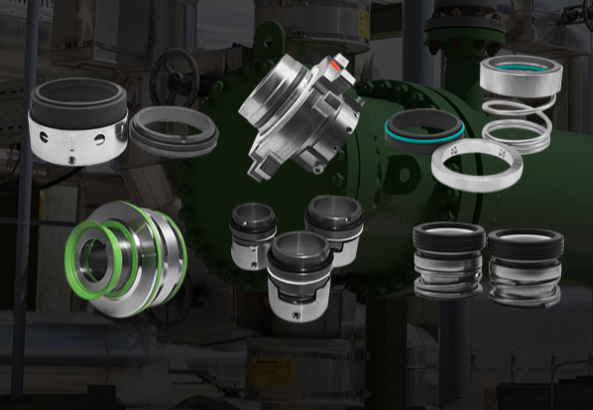
Description: These seals use a flexible rubber bellows instead of a spring. The bellows provides both the sealing force and compensates for misalignment.
Advantages:
Very compact and lightweight.
Good corrosion resistance in mild chemical environments.
Cost-effective for low-pressure clean water applications.
Typical Applications: Small domestic pumps, aquarium pumps, washing machine pumps.
Description: Two seals arranged in series or back-to-back with a barrier fluid (usually clean water or glycol) circulating between them.
Advantages:
Provides a safety buffer zone — if the primary seal fails, the secondary seal still holds.
Prevents pumped fluid from leaking to atmosphere.
Essential for hazardous, toxic, or abrasive fluids.
Typical Applications: Wastewater treatment, chemical dosing pumps, slurry handling.
The performance and lifespan of a mechanical seal depend heavily on three material groups: the sealing faces, the secondary seals (elastomers), and the metal hardware.
| Material | Properties | Best For |
|---|---|---|
| Carbon vs. Silicon Carbide (SiC) | Carbon is soft, self-lubricating, and conforms well. SiC is extremely hard, wear-resistant, and chemically inert. | General water (Carbon vs. SiC); abrasive or high-temp water (SiC vs. SiC). |
| Tungsten Carbide (WC) | Very hard, excellent abrasion resistance. | Sandy water, well water, slurry applications. |
| Alumina Ceramic | Hard, smooth, and economical. | Low-cost domestic pumps, clean water only. |
Common Pairings:
Carbon vs. Silicon Carbide (C/SiC): Most common for clean water; good balance of cost and life.
Silicon Carbide vs. Silicon Carbide (SiC/SiC): Recommended for dirty, abrasive, or high-temperature water; superior wear life.
Carbon vs. Alumina Ceramic (C/Al₂O₃): Budget option for light-duty pumps.
| Material | Temperature Range | Resistance | Typical Use |
|---|---|---|---|
| NBR (Buna-N) | -30°C to +100°C | Good oil & water resistance | Standard clean water, general purpose |
| EPDM | -40°C to +150°C | Excellent hot water & steam resistance | Hot water pumps, boiler feed |
| FKM (Viton®) | -20°C to +200°C | Excellent chemical & heat resistance | Aggressive chemicals, high-temp water |
| PTFE (Teflon®) | -200°C to +260°C | Nearly universal chemical resistance | Corrosive fluids, extreme temperatures |
Stainless Steel (SS304 / SS316): Standard choice for water pumps; SS316 offers better corrosion resistance for brackish or chlorinated water.
Hastelloy® C276: Used in highly corrosive environments.
Inconel® 625: For metal bellows in extreme high-temperature applications.
Follow this simple decision flow to specify the ideal mechanical seal for your application:
Fluid Type: Is it clean water, hot water, wastewater, or chemically treated water?
Temperature: Above 100°C? Consider metal bellows + SiC faces + EPDM/FKM.
Abrasives (sand, silt)?: Choose SiC vs. SiC faces, or Tungsten Carbide if conditions are severe.
Installation Preference: Want quick, error-proof replacement? Go with a pre-assembled cartridge seal.
Budget Constraints: Standard O-ring push-type seals with carbon vs. alumina are the most economical choice.
Understanding the common types and materials of mechanical seals empowers pump operators, maintenance engineers, and procurement professionals to make informed decisions. Whether you are maintaining a small domestic water pump or managing a large industrial cooling system, selecting the correct seal configuration directly translates into longer pump life, reduced downtime, and a lower total cost of ownership.
For customized solutions or specific OEM replacements, always consult with a reliable manufacturer like Ningbo Miaoyu Mechanical Technology Co., Ltd., which specializes in producing high-quality mechanical seals for global water pump applications.

Our company is specialized in the production of sealing materials, mechanical seals , cartridge seals.
E-mail: gechacha@aliyun.com
Mobile: +86-18758835650
WhatsApp: +86-18758835650
Add: No8-2, Jinsha road Yuelin Street, Fenghua District, Ningbo, Zhejiang


