

Mechanical seals are critical components in rotating equipment, preventing fluid leakage between rotating shafts and stationary housings. Among the various types, metal bellows mechanical seals and O-ring mechanical seals represent two fundamentally different design philosophies. This article provides an in-depth comparison of these two sealing technologies, examining their working principles, advantages, limitations, and ideal applications.
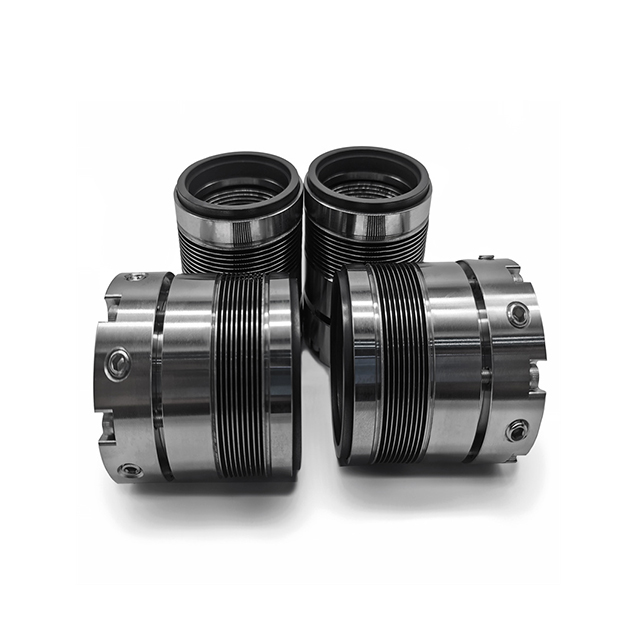
Metal bellows seals utilize a flexible, welded metal bellows assembly that serves both as a spring mechanism and a secondary sealing element. The bellows, typically made from stainless steel or Hastelloy, consists of multiple convolutions that allow axial movement while maintaining pressure integrity. This design eliminates the need for a dynamic secondary seal (like an O-ring) between the rotating face and the shaft. The bellows itself compensates for shaft runout, thermal expansion, and wear, while providing the necessary closing force to maintain face contact.
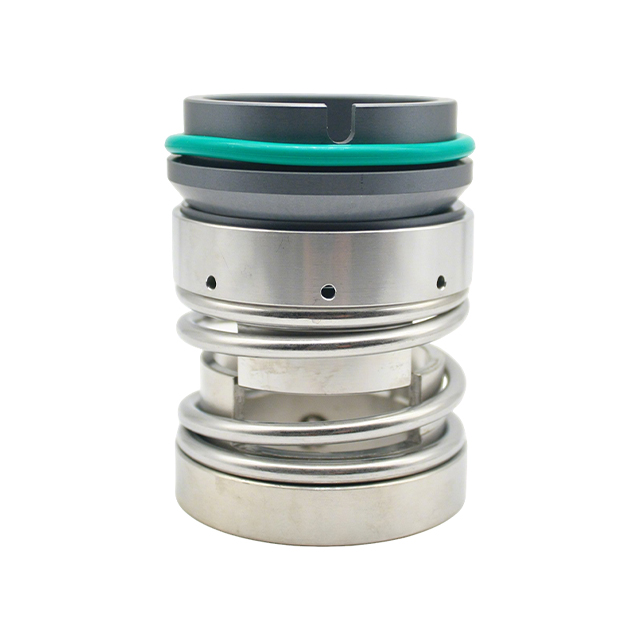
O-ring seals rely on elastomeric O-rings as secondary sealing elements. These seals use a separate spring mechanism—typically a single large spring or multiple small springs—to provide the closing force. The O-ring sits between the rotating face and the shaft sleeve, accommodating minor misalignments and axial movement through its elastic deformation. The primary sealing faces are similar to those in bellows seals, but the secondary sealing relies entirely on the O-ring's resilience and compression set resistance.
Feature | Metal Bellows Seal | O-Ring Seal |
|---|---|---|
Secondary Seal | Integral bellows | Elastomeric O-ring |
Spring Mechanism | Bellows itself | Separate coil/springs |
Number of Dynamic Seals | One (primary face) | Two (face + O-ring) |
Temperature Range | -200°C to 450°C | -40°C to 250°C (typical) |
Pressure Capability | Up to 35 bar (standard) | Up to 70 bar (with balanced design) |
Metal bellows seals excel in high-temperature environments where elastomeric O-rings would fail. The all-metal construction withstands temperatures up to 400°C or higher with appropriate materials, making them ideal for hot water, thermal oils, and molten salts. O-ring seals typically limit to 200-250°C due to elastomer degradation, though specialized compounds like FKM or FFKM can extend this range.
Bellows seals offer superior chemical compatibility since only metal contacts the process fluid. They handle aggressive chemicals, acids, and caustics that would attack elastomers. O-ring seals require careful material selection—while PTFE-lined O-rings exist, they often lack the elasticity needed for effective sealing, leading to higher leakage rates.
O-ring seals generally handle higher pressures more effectively. The separate spring mechanism can be designed for specific pressure ranges, and balanced designs easily manage pressures exceeding 100 bar. Metal bellows seals face limitations because excessive pressure can cause bellows collapse or plastic deformation. However, reinforced bellows designs have improved high-pressure performance.
Both designs accommodate shaft runout and misalignment, but through different mechanisms. Bellows seals flex along their entire length, providing excellent angular misalignment capability. O-ring seals rely on the O-ring's ability to roll within its gland, which works well for axial movement but may struggle with severe angular misalignment.
Advantages:
No dynamic elastomer degradation over time
Excellent high-temperature performance
Superior chemical resistance
Reduced number of leak paths
Better handling of viscous or sticky fluids (no O-ring hang-up)
Longer service life in clean applications
Disadvantages:
Higher initial cost
Limited pressure capability compared to O-ring designs
Susceptible to vibration-induced fatigue failure
Cannot tolerate dry running conditions
More difficult to install correctly
Potential for bellows clogging in dirty fluids
Advantages:
Lower initial cost
Higher pressure capabilities
Easier installation and replacement
Better tolerance for contaminated fluids
Wider availability of standard sizes
More forgiving of installation errors
Disadvantages:
O-ring degradation limits temperature range
Chemical compatibility issues with elastomers
Multiple potential leak paths
O-ring swelling or extrusion problems
Requires periodic O-ring replacement
Performance degrades with O-ring hardening
High-temperature services (>250°C)
Cryogenic applications (<-50°C)
Aggressive chemical processing
Food and pharmaceutical industries (hygienic design)
High-speed applications (up to 25 m/s)
Low-viscosity fluids (liquified gases, light hydrocarbons)
General industrial water pumping
High-pressure boiler feed pumps
Slurry and abrasive services
Applications requiring frequent seal changes
Standard API 682 configurations
Cost-sensitive installations
Metal bellows seals typically offer longer mean time between failures (MTBF) in suitable applications, often lasting 3-5 years without intervention. However, when failure occurs, repair is complex and often requires factory service. O-ring seals have shorter MTBF (typically 1-3 years) but allow field replacement of O-rings, reducing downtime and maintenance costs.
The total lifecycle cost analysis should consider:
Initial purchase price (bellows: 30-50% higher)
Installation labor (bellows: more expensive)
Expected service life
Downtime costs during replacement
Spare parts inventory requirements
Recent developments include hybrid designs combining bellows flexibility with O-ring pressure capabilities. Advanced materials like shape memory alloys for bellows and perfluoroelastomers for O-rings continue to push performance boundaries. Additionally, condition monitoring systems now predict seal failure by tracking bellows deflection or O-ring compression set, enabling predictive maintenance strategies.
The choice between metal bellows and O-ring mechanical seals depends on specific operating conditions, not general superiority. Metal bellows seals dominate high-temperature, corrosive, and hygienic applications where elastomer incompatibility poses risks. O-ring seals remain the workhorse for general industrial applications, offering proven reliability, cost-effectiveness, and ease of maintenance at moderate temperatures and pressures.
Engineers must evaluate process parameters including temperature, pressure, fluid chemistry, contamination levels, and speed requirements. When properly selected and installed, both designs provide reliable sealing solutions—the key lies in matching the seal technology to the application's unique demands rather than defaulting to one type over another. As material science advances, the gap between these technologies narrows, but fundamental design differences will continue to define their optimal application envelopes.


Our company is specialized in the production of sealing materials, mechanical seals , cartridge seals.
E-mail: gechacha@aliyun.com
Mobile: +86-18758835650
WhatsApp: +86-18758835650
Add: No8-2, Jinsha road Yuelin Street, Fenghua District, Ningbo, Zhejiang


